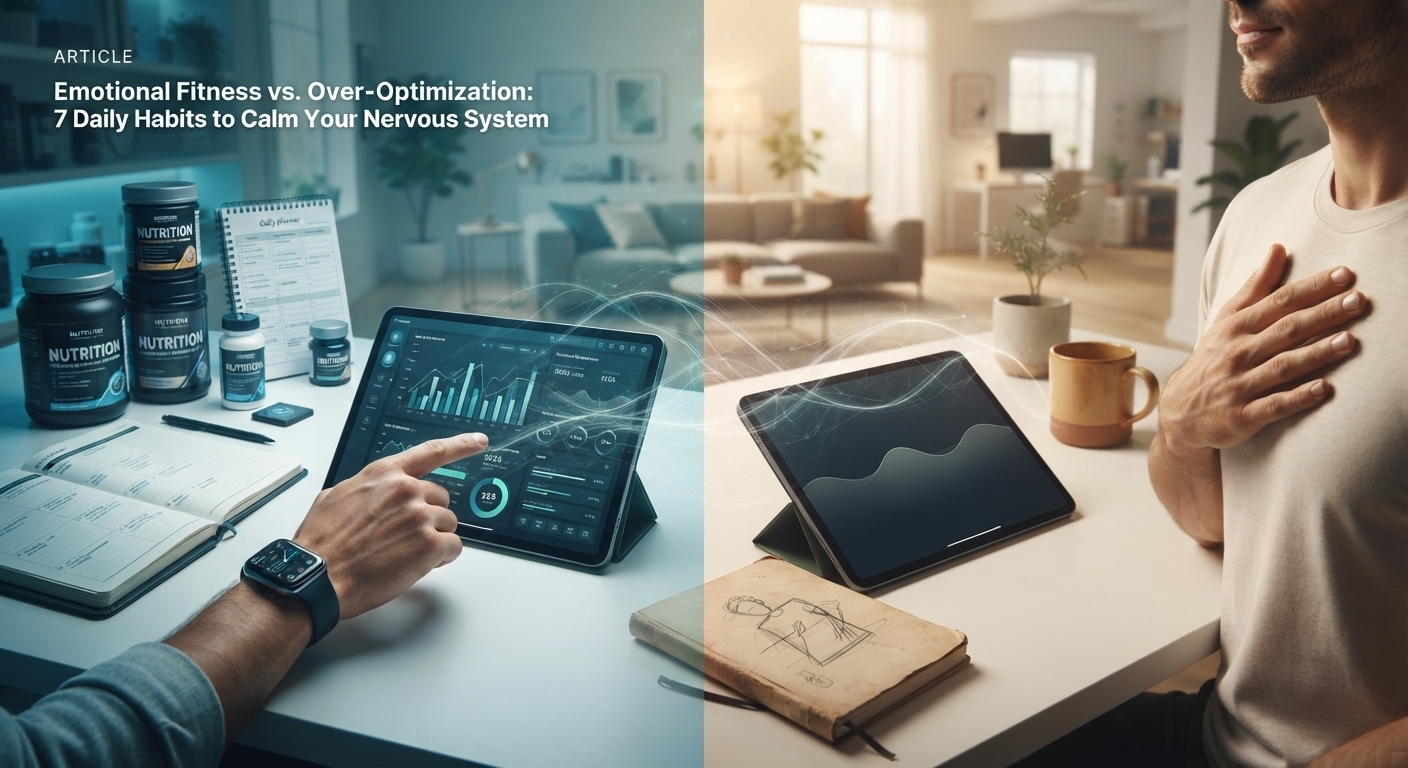
The Hidden Cost of Wellness Over-Optimization
What Emotional Fitness Actually Means
-
Notice internal shifts early through interoception—your brain’s perception of internal bodily sensations like chest tightness, shallow breathing, or jaw clenching.
-
Tolerate emotional discomfort without immediately numbing out, snapping at others, or spiraling into catastrophic thinking.
-
Down-regulate sympathetic arousal by sending reliable, physical signals of safety to the vagus nerve and broader autonomic network.
-
Recover baseline composure faster after conflict, overload, or unexpected disruption.
Emotional Fitness vs. Over-Optimization: A Quick Comparison
| Dimension | Over-Optimization | Emotional Fitness |
| Core Objective | Maximizing output, metrics, and control | Building adaptability, recovery, and composure |
| Response to Stress | Adding more rules, trackers, or rigid protocols | Down-regulating the nervous system and simplifying |
| Relationship With Rest | Treated as a productivity tool to be earned | Treated as a non-negotiable biological baseline |
| Handling Setbacks | Self-criticism, guilt, and all-or-nothing resets | Curiously observing friction and adjusting without shame |
| Nervous System Impact | Subtle, chronic sympathetic hyper-vigilance | Fluid oscillation between focus and parasympathetic calm |
7 Daily Habits to Calm Your Nervous System
1. Take 3-Minute Physiological Micro-Breaks
2. Practice Granular Affect Labeling
3. Protect Low-Stimulation Downtime
4. Anchor Your Circadian Rhythm With Morning Daylight and Light Movement
5. Use Somatic Orienting to Interrupt Threat Loops
6. Establish Clean Transitions Between Work and Rest
-
Close open browser tabs and write down the top two priorities for tomorrow so your brain stops rehearsing them overnight.
-
Change out of your work clothes, wash your face, or take a warm shower to mark a sensory shift.
-
Put work devices out of reach or silence non-essential notifications until morning.
7. Set Predictable Evening Wind-Down Boundaries
How to Build Emotional Fitness Without Turning It Into Another Checklist
-
Start With One Anchor Habit: Pick the single habit that addresses your biggest daily bottleneck—whether that is afternoon screen fatigue, evening restlessness, or constant sensory overload. Practice it consistently for two weeks before adding anything else.
-
Aim for 70% Consistency, Not 100% Perfection: Real life includes travel, deadlines, sick days, and unexpected disruptions. Emotional fitness is measured by how gently you return to your baseline after a chaotic day, not by an unbroken streak on an app.
-
Measure Success by How You Feel, Not Just What You Track: Notice subtle shifts. Are you recovering faster after a tense meeting? Is your jaw less clenched while driving? Are you falling asleep with less mental chatter? Those lived signals matter far more than any wearable score.