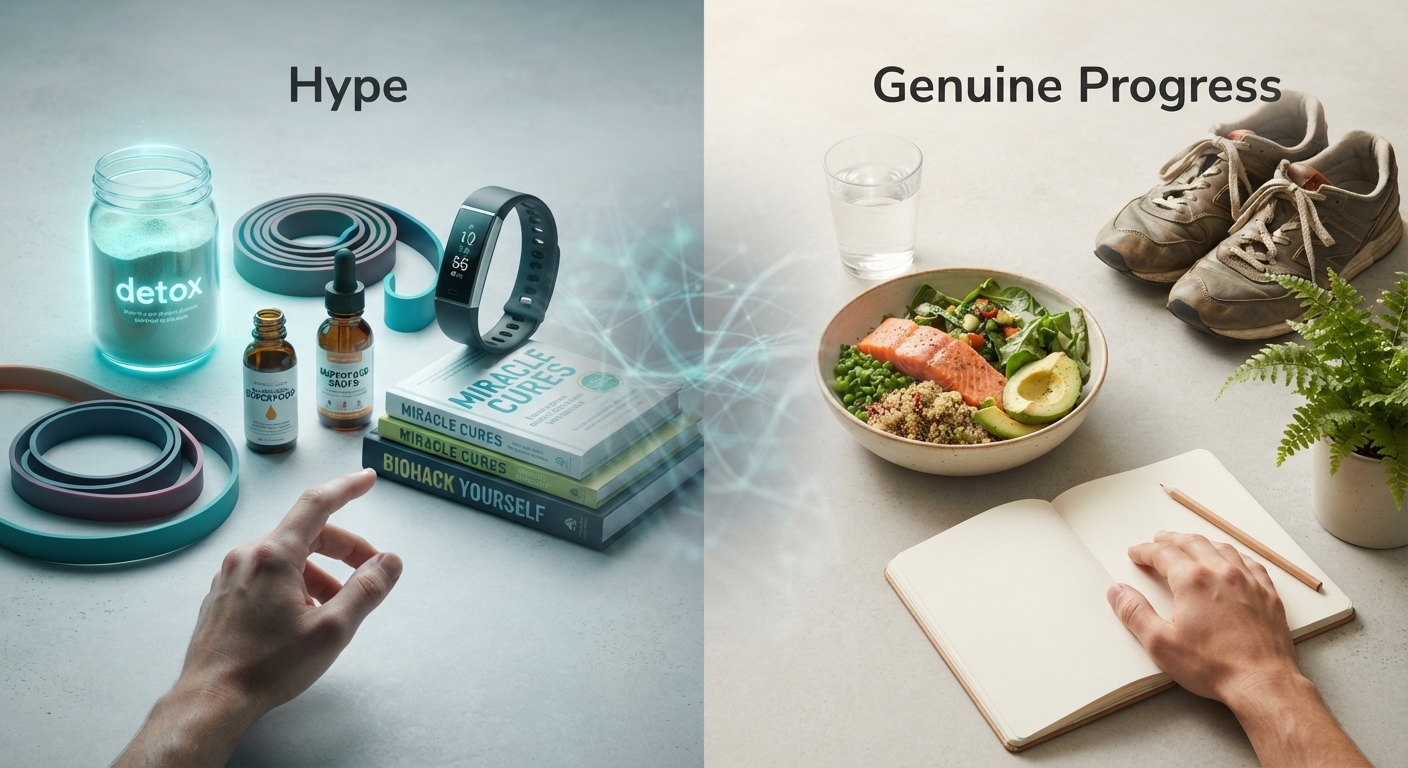
The Anatomy of Hype: Why We Believe
The Bedrock of Reality: What Cannot Be Replaced
1. Sleep Architecture: The Foundation of Restoration
2. The Nutrient Matrix: Food as Information
3. Somatic Integrity: The Requirement for Movement
4. Allostatic Balance: The Management of Stress
A Framework for Evaluation: How to Spot the Signal
1. Is There Real Evidence Behind It?
-
Correlation vs. Causation: Be wary of observational studies that show a link between two variables but cannot prove one caused the other. The gold standard is the randomized controlled trial (RCT), where one group receives the intervention and the other receives a placebo, and participants are assigned randomly.
-
Cherry-Picking Anecdotes: A trend built on a single, dramatic before-and-after photo or a compelling testimonial is suspect. Legitimate progress is measured over time and across diverse populations. Look for consistent findings replicated across multiple independent studies, summarized in systematic reviews or meta-analyses.
-
Human vs. Animal or In-Vitro Research: A compound that extends the lifespan of yeast or shows anti-cancer properties in a petri dish is interesting, but it is a monumental leap to assume it will have the same effect in a complex, free-living human. Always check if the purported benefits have been demonstrated in human clinical trials.
-
The Quality of the Journal: Not all scientific journals are created equal. Be skeptical of research published in predatory journals that lack rigorous peer review. Look for studies in established, reputable publications (e.g., NEJM, JAMA, The Lancet, Cell, Nature).
2. Does It Target a Biological Mechanism or a Symptom?
3. Are the Risks and Costs Clearly Explained?
-
The Dose Makes the Poison: A supplement that is beneficial in small doses can become toxic in high concentrations. For example, excessive vitamin D supplementation can lead to hypercalcemia, causing kidney damage and cardiac issues.
-
Contraindications and Interactions: A trending herb or supplement may interfere with prescription medications. St. John’s Wort, for instance, is notorious for interacting with antidepressants, birth control pills, and blood thinners, rendering them less effective or causing dangerous side effects.
-
Financial Opportunity Cost: Every dollar spent on a trendy, scientifically tenuous supplement is a dollar not spent on high-quality food, a gym membership, or therapy. Evaluate the cost-to-benefit ratio realistically.
4. Is It Sustainable as a Lifestyle?
Case Studies in Hype vs. Reality
Trend 1: The Daily Celery Juice Protocol
-
The Claim: Drinking 16 ounces of celery juice on an empty stomach every morning can heal chronic illnesses, reverse autoimmune conditions, and detoxify the liver.
-
The Evaluation:
-
Evidence: There is zero robust human clinical evidence supporting the specific claims made about celery juice. The proponent of this trend cites “undiscovered cluster salts.” This is pseudoscientific terminology.
-
Mechanism: Celery contains antioxidants and compounds like apigenin and luteolin, which have anti-inflammatory properties in laboratory studies. However, these compounds are not unique to celery and are present in many vegetables. There is no mechanism by which celery juice uniquely “detoxifies” the liver in a way that water and a balanced diet do not.
-
Risks/Cost: It is generally safe, but the cost of juicing celery daily is non-trivial. The primary risk is the opportunity cost of believing it replaces conventional medical treatment for serious conditions.
-
Sustainability: Moderate. It requires juicing and cleaning equipment daily.
-
-
Verdict: Hype. While celery is a healthy food, the extraordinary claims surrounding its juice are not supported by evidence.
Trend 2: Strength Training for Longevity
-
The Claim: Resistance training, particularly as one ages, is critical for maintaining muscle mass (sarcopenia prevention), bone density (osteoporosis prevention), metabolic health, and functional independence.
-
The Evaluation:
-
Evidence: There is an overwhelming body of robust human research, including numerous meta-analyses and systematic reviews, demonstrating the profound health benefits of resistance training across the lifespan.
-
Mechanism: Mechanical loading from resistance training stimulates muscle protein synthesis (hypertrophy) and signals bone formation. It also improves insulin sensitivity and increases resting metabolic rate. The mechanisms are well-understood and validated.
-
Risks/Cost: The primary risk is injury from improper form, which can be mitigated by professional instruction. The cost is variable, ranging from a home set of dumbbells to a commercial gym membership.
-
Sustainability: High. It can be adapted to any age, fitness level, and time constraint.
-
-
Verdict: Genuine Progress. Strength training is a foundational pillar of health supported by irrefutable evidence.
Trend 3: Cold Plunges for Systemic Inflammation and Mental Resilience
-
The Claim: Immersing the body in near-freezing water reduces systemic inflammation, speeds up muscle recovery, boosts the immune system, and builds mental toughness.
-
The Evaluation:
-
Evidence: Evidence is emerging and mixed. While cold exposure does trigger a significant hormonal response (norepinephrine surge), studies on muscle recovery are conflicting; some show a blunting effect on hypertrophy if done immediately after lifting (due to suppression of necessary inflammation). Mental resilience training is inherently subjective but supported by the psychology of voluntary exposure to discomfort.
-
Mechanism: The cold triggers vasoconstriction (reducing swelling) followed by vasodilation (flushing). The hormonal cascade explains the immediate alertness. The mechanisms are being actively researched.
-
Risks/Cost: Significant. There is a risk of hypothermia and cold-shock response, which can be dangerous for individuals with pre-existing cardiovascular conditions. The cost of entry for a proper setup (chiller, tub) is high.
-
Sustainability: Low-to-Moderate. It requires significant setup, maintenance, and a high degree of tolerance for acute discomfort.
-
-
Verdict: Niche/Conditional Progress. This is a powerful tool with specific applications (e.g., acute injury management, mental resilience) but is not a universal panacea, and its timing relative to other training is critical. It is largely unnecessary for general health.
The Empowered Consumer: Navigating the Hype Cycle
-
Practice Intellectual Humility: Recognize that your intuition about health is often biased. Be willing to admit that what you want to be true is not necessarily supported by reality.
-
Beware the “Appeal to Nature”: The fact that a substance is “natural” does not guarantee its safety or efficacy. Arsenic is natural. Snake venom is natural. Many of the most potent pharmaceutical drugs are derived from nature, but they are standardized, purified, and dosed. A “natural” supplement is an unregulated drug.
-
Follow the Money: Investigate who is promoting the trend. Are they a credentialed expert (MD, PhD, RD) with no financial tie to the product, or an influencer with an affiliate code? While credentialing is not a guarantee of correctness, a lack of it, combined with a financial interest, is a major red flag.
-
Demand Replicability: A true scientific finding can be replicated by independent researchers. If a protocol is based on a single study that cannot be verified, treat it as folklore, not fact.
-
Embrace Boredom: The most effective health interventions—sleep, walking, eating vegetables, lifting weights, managing stress—are profoundly unsexy. They do not lend themselves to viral video trends. This is precisely why they work. They are the fundamentals, and in health, the fundamentals are everything.